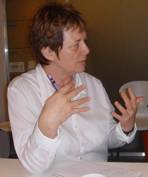
Elin Rønby Pedersen, PhD

mailto:elin@elin.us

General profile

Working in research, R&D and product strategy, Elin Pedersen has repeatedly demonstrated an acute sense for technology opportunities created by users’ desires, capabilities, and experiences. She brings a unique combination of skills to the table: she architects and develops software; she observes people and translates the observations into innovations; and she also has a strong sense of design.

Backed by advanced degrees in Computer Science and Humanities, she has more than 15 years of experience working for leading US research labs, and she has done pioneering HCI (Human Computer Interaction) research, going beyond the confines of goal-oriented work at the desktop, making computing a vital and delightful part of our everyday lives. That includes a broad range of HCI themes:

  • Facile HCI, sketching and similar informal activity, using pens or hand gestures (Tivoli)
  • Social HCI, supporting social interaction and connectivity (Shared Tivoli, Casablanca, AROMA)
  • Mobile HCI, bringing computing beyond the desktop: handheld technology for sensory supplement (TactGuide), and mobile social awareness (Calls.calm)
  • Tangible HCI, instrumenting paper to interface digital contents and processes (Palette, PaperButton, client work)
  • Implicit HCI, creating interaction that requires neither premeditation, nor explicit monitoring (low-intentional and low-attentional), thus providing social and situational awareness to help social interaction (AROMA) and support memory (Firebird)

In recent years she has increasingly focused on two hard questions: how to make research have more impact on products without losing its “disruptive” quality, and how to make better decisions about where to spend limited research resources. She co-developed a blueprint for an innovation process (UITTL) that embraces both technology prototyping and ethnographic exploration of usage domains.

Education

Ph.D., Computer Science, University of Copenhagen, Denmark, 1988

M.Sc., Computer Science, University of Copenhagen, Denmark, 1982

B.A., Nordic Literature and Language, University of Aarhus, Denmark, 1978

Employment history (post PhD only)

2005 - current, Microsoft, Redmond, WA

Senior Researcher

Joined Microsoft, office of the CTO, Platform Technology and Strategy, to provide vision and direction for incubation projects that merge rapid, innovative prototyping with ethnographic research.

She scoped R&D efforts of existing 5-person team to focus on activity-based relationships as a 1st class citizen in the information worker domain. Spearheaded technology innovation on capturing and exposing relationships between documents based on automatically captured usage patterns.

She provided key insights to data analysis (ethnographic field findings) and added an innovative technology component to a UI conceptual design.


2001 - 2005, Kraka, Inc., Redwood City, CA

Principal, strategy advisor and chief prototyper

Founded the Redwood City based consulting company, Kraka, Inc., to help clients (corporate research centers, R&D groups, and product planning groups) transform promising technology into appealing product concepts - primarily by organizing an innovative process (UITTL) that combines rapid prototyping and user experience insights.

Elin oversaw all aspects of Kraka’s operation, learning hands-on the challenges of running a small business and leveraging peer professionals. Engagements included:

Methodology: Helped build user experience teams for clients, recruited and trained a strong multi-disciplinary team of user experience researchers, designers and prototypers. Created and evangelized the UITTL innovation process that develops and assesses value proposition for novel technology.

Exploration: Conducted brief ethnographies and workflow analysis for several R&D projects aimed to identify and chart promising user domains. Worked closely with business strategists to help a couple of large US universities improve their intellectual property processes. Specific contributions include gathering stakeholder experience and translating these into action items and web-service designs.

Prototyping: Provided technical leadership for rapid prototyping of a personal and personalizable portal to contact information and devices. Designed and implemented web-based professional communities, supporting a large distributed and only loosely connected research collaboration (NSF industry/university cooperative research center, including 10 major industry partners). Both projects deployed MVC architecture, scripts, servlets, beans, and relational databases.


2000-2002, Cisco Systems, Inc., San Jose, CA

SE engineer level V, visionary lead in User Centered Design group

Joining Cisco to help them serve a new, much wider and more diverse user population brought about by Cisco’s entry into the market of IP telephony. Elin produced brief ethnographies, Day-in-the-life narratives, use cases and fast low-fidelity prototyping, all of which helped IP telephony engineers envision their prospective users, and supported their ongoing decision-making as they progressed towards a beta product. She also enhanced the central usability effort by designed processes for early engagement of user experience in production cycle.


1997-2000, Fuji Xerox Palo Alto Laboratory, Palo Alto, CA

Senior research scientist, manager of several research projects

Elin developed and led the research program Tacit Interaction, centered on making technology supplement human expertise, rather than substituting it (see also Stanford talk on "Tacit Interaction" in MURL, http://murl.microsoft.com/LectureDetails.asp?265. She defined the research agenda, managed a team of 4-6 other researchers and interns, and took active part in the delivery by building prototypes (in java, WML, servlets, SQL), and conducting user/usage studies. She so-invented paper-based interaction technologies using tags like barcodes, RFID, etc. (Palette and PaperButtons)

She developed and led a research program for mobile communication HCI: (1) Bringing people's social interaction skills to bear on mediated communication and "getting in touch"; and (2) Looking at each phone interaction as part of an ongoing interaction. (Calls.calm)

She introduced the so-called innovation workshops into the lab to help prioritize and focus research activity. One workshop packaged data and analysis material from ethnographic study of mobile work in a Fortune 500 sales force, and had a significant impact on the following year’s research program.


1996-1997, Roskilde University, Denmark

Associate professor in Computer Science

Elin supervised graduate students, and taught graduate courses on HCI, Java/Object oriented programming and introductory computer graphics. Ported Tivoli-like informal sketching functionality to the Java and web.

She developed and led the AROMA research program, exploring technologies to support expanded peripheral awareness: (1) Provided data for people to allow them be "peripherally aware" of situations where they are not physically present; (2) Solved some of the tough privacy problems in home based media spaces by using abstract representation of activity (and at the same time solving serious bandwidth problems)


1994-1996, Interval Research Corporation, Inc., Palo Alto, CA

Member of research staff, manager of research project

Elin explored gesture-rich interaction technologies using large interaction surfaces to support remote collaboration (LookingGlass with gestures)

She pioneered the research domain of domestic media space technology (Casablanca); prototyping in Director and C++. Conducted ethnographic study in domestic settings of people and technology


1992-1994, Roskilde University, Denmark

Associate professor in Computer Science

Elin supervised graduate students, and taught graduate courses on HCI, Java/Object oriented programming and introductory computer graphics.

She developed and led the Scribble research agenda for multidisciplinary effort in sketching and gesture based interaction, funded by the Danish Science and Technology Research Council


1990-1991, Xerox Palo Alto Research Center, Palo Alto, CA

Member of research staff

Elin joined the ubiquitous computing program under Dr. Mark Weiser's leadership, primarily contributing as front-end programmer (C++ and X-windows) and co-visionary on tools for early idea sketching. She developed a walkup user interfaces for the Liveboards; developed distributed software architectures by replication (Tivoli); and invented technologies for pen interaction for wall-sized interaction surfaces (Tivoli)


1988-1991, Copenhagen Business School, Denmark

Assistant professor in Computer Science

Elin explored formalization and computer support in intellectual work

Other professional services

Member of Association for Computing Machinery (ACM) and sub committees: SIGCHI, SIGMOBILE, BayCHI, and Institute of Electrical and Electronics Engineers, Inc (IEEE). Committee member and reviewer for several international journals and conferences (CACM, TOCHI, TOIS, HCI Journal; CHI, CSCW, UIST, etc.). Visiting scholar with Stanford University, Center for the Study of Language and Interaction (CSLI) and Scandinavian Consortium for Organizational Research (ScanCor).

Elin has regularly mentored younger co-workers and young professionals. She has also been engaged in mentoring Stanford University projects for many years, typically in projects that deal with case studies and "real world" client contact.

Patents and publications

Inventor of 9 issued patents and 5 pending patents, and author/co-author of numerous scientific papers in peer reviewed publications, i.e., book chapters, conference proceedings and journal articles. A thematic index to papers and patents (including links to local copies of papers) can be found at http://www.kraka.com/ElinPedersen/currPortfolio.html. And finally, a portfolio of interaction designs. mostly from the 90s, can be found at this address, http://www.kraka.com/DesignPortfolio/index.html 

Other interests and passions

Elin is passionate (and opinionated) about design and architecture in the physical world. Having a can-do mentality in most matters, she is well versed in construction methods, building code, and import regulation (to bring in her favorite objects of design),

She is also an avid reader of fiction, sometimes dreaming of retiring as a writer.

Citizenship

Danish citizen; permanent resident of the United States since 2000


Publications and patents

Elin Rønby Pedersen, PhD

mailto:elin@elin.us


Dissertations

M.Sc. thesis

Strategic IT Planning in Small Community (Written in Danish: Edb-helhedsplanlægning. Speciale i datalogi. DIKU-82/5). Copenhagen University, 1982

Ph.D. thesis

Notation Usage in Computer Program Development: Studies of Programmers’ Description and Theory Building. (In Danish: Notation i datamatisk program-udvikling. Studier af programmørers beskrivelser og teoribygning. Licentiat-afhandling.) English summary available. Copenhagen University, 1987


Publications (peer reviewed)

2005:

Elin Rønby Pedersen, Jeanine Spence, David McDonald: User Activity Monitoring as Source for Inter-Document Relationships. Submitted for review.


Elin Rønby Pedersen: Empowering the Caller: Restoring Collaboration and Context in Communication. Submitted for review.


Francesca Barrientos, Elin Rønby Pedersen, Irem Y. Tumer: Towards failure based decision making during design: user-centered design meets design methods research. In Proceedings of SMC 2005 conference Hawaii, IEEE Press, 2005

2002:

Tomas Sokoler, Les Nelson and Elin Rønby Pedersen: Low-Resolution Supplementary Tactile Cues for Navigational Assistance. In Conference Proceedings of Mobile HCI 2002, Lecture Notes in Computer Science series, Springer-Verlag

2001:

Elin Rønby Pedersen: Calls.Calm: Enabling Caller and Callee to Collaborate. Proceedings of CHI 2001 Conference, Extended Abstracts, Seattle, ACM Press, 2001.

2000:

Satoshi Ichimura, Les Nelson, and Elin Rønby Pedersen: CardGear: A Present-ation System Manipulated with Paper Cards. (Written in Japanese). In Proceed-ings of Interaction 2000 Symposium, Information Society of Japan. Pp. 17-24.


Elin Rønby Pedersen, Tomas Sokoler, Les Nelson: PaperButtons: Expanding a Tangible User Interface. In Proceedings of DIS'2000, ACM

1999:

Les Nelson, Satoshi Ichimura, Lia Adams, and Elin Rønby Pedersen: Palette: A Paper Interface for Giving Presentations. In Proceedings of CHI'99 (Pittsburgh, PA, April 1999), ACM Press

1998:

Elin Rønby Pedersen: People Presence or Room Activity. Proceedings of CHI 98 conference, Los Angeles, ACM Press

1997:

Elin Rønby Pedersen and Tomas Sokoler: AROMA - Abstract representation of mediated presence supporting mutual awareness. Proceedings of CHI 97 conference, Atlanta, ACM Press, 1997.


Elin Rønby Pedersen and Lucy Suchman (eds.): Pleasure and technology. Collection of position statements for the 7th Oksnøen Symposium, June 1997.


Elin Rønby Pedersen and Tomas Sokoler: Awareness Technology: Experiments With Abstract Representation. Proceedings of HCI International '97 conference, San Francisco, Elsevier Publ, August 1997.

1996:

Elin R. Pedersen and Lucy Suchman (eds.): Images of technology. Collection of position statements for the 6th Oksnøen Symposium, May 1996.

1995:

Elin Rønby Pedersen, Kim McCall, Thomas Moran, Frank Halasz: Tivoli: An Electronic Whiteboard for Informal Workgroup Meetings. Baecker, Grudin, Buxton, Greenberg (eds.), Readings in Human-Computer Interaction: Toward the Year 2000. Morgan Kaufmann Publishers, May 1995.


Elin Rønby Pedersen and Lucy Suchman (eds.): Presence: being Here and There, Nowhere and Everywhere. Collection of position statements for the 5th Oksnøen Symposium, May 1995.


Thomas Moran, Kim McCall, Bill van Melle, Elin Rønby Pedersen, and Frank Halasz: Some Design Principles for Sharing in Tivoli, a Whiteboard Meeting Support Tool. S. Greenberg, Haynes, and Rada (eds.) Real-Time Group Drawing and Writing Tools, pp 24-36. McGraw-Hill Book Company of Europe, 1995.

1994:

Elin Rønby Pedersen and Lucy Suchman (eds.): Locating Design, Development, and Use. Collection of position statements for the 4th Oksnøen Symposium, 1994.

1993:

Scott Elrod, Richard Bruce, David Goldberg, Frank Halasz, William Janssen, David Lee, Kim McCall, Elin Rønby Pedersen, Ken Pier, John Tang and Brent Welch: Liveboard: A large interactive display supporting group meetings, presentations and remote collaboration. Chapter 12 in Ronald M. Baecker (ed.) Readings in Groupware and Computer Supported Cooperative Work: Assisting Human-Human Collaboration. Morgan-Kaufmann Publishers, 1993, pp 709-17


Elin Rønby Pedersen, Kim McCall, Thomas Moran, Frank Halasz: Tivoli: An Electronic Whiteboard for Informal Workgroup Meetings. Proceedings of the InterCHI conference, Amsterdam April 1993, ACM, 1993.


Elin Rønby Pedersen and Lucy Suchman (eds.): Understanding work practice. Collection of position statements for the 3rd Oksnøen Symposium, May 1993.

1992:

Elin Rønby Pedersen and Lucy Suchman (eds.): Customizing Software Systems: when, how, by whom, why not .... Collection of position statements for the 2nd Oksnøen Symposium, May 1992.


Scott Elrod, Richard Bruce, David Goldberg, Frank Halasz, William Janssen, David Lee, Kim McCall, Elin Rønby Pedersen, Ken Pier, John Tang and Brent Welch: Liveboard: A large interactive display supporting group meetings, presentations and remote collaboration. Proceedings from CHI '92 Conference on Human Factors in Computing Systems, Monterey, CA, 1992.

1991:

Elin Rønby Pedersen and Lucy Suchman (eds.): Knowing and Knowledge: Re-specifying the role of formalization in social and computer science. Collection of abstracts for the first Oksnøen Symposium, 1991.


Patents Issued (for an up-to-date list, try this link to USPTO )


System and method for managing electronic communications. U.S. Patent 6,842,512; published January 11, 2005. Inventor: Elin Rønby Pedersen.


System and method for maintaining consistent uniformity in a presentation environment. U.S. Patent 6,580,438; Published June 17, 2003, filed 11/29/99. Inventors: Satoshi Ichimura, Les Nelson, Elin Rønby Pedersen


Systems and methods for controlling a presentation using physical objects. U.S. Patent 6,509,909. Published Jan 21 2003; filed Nov 1, 2000. Inventors: Les Nelson, Lia Adams, Satoshi Ichimura, Elin Rønby Pedersen, Steve Smoliar.


Systems and methods for controlling a presentation using physical objects. U.S. Patent 6,195,093 (6,509,909). Filed 9/14/99. Inventors: Les Nelson, Lia Adams, Satoshi Ichimura, Elin Rønby Pedersen, Steve Smoliar.


Systems and methods for controlling a presentation using physical objects. U.S. Patent 6,732,915 ; filed 9/10/99, issued May 11, 2004. Inventors: Les Nelson, Satoshi Ichimura, Elin Rønby Pedersen, Tomas Sokoler. [PaletteX]


Systems and methods providing tactile guidance using sensory supplementation. U.S. Patent 6,320,496. Issued Nov 20, 2001, filed 4/29/99. Inventors: Tomas Sokoler, Les Nelson, Elin Rønby Pedersen.


Variable bandwidth communication systems and methods. U.S. Patent 6,282,206. Issued Aug. 28, 2001, filed Oct. 9, 1998. Inventors: Debby Hindus, Scott Mainwaring, Elin Pedersen, Sean Michael White, and William Gaver.


Wiping metaphor as a user interface for operating on graphical objects on an interactive graphical display. U. S. Patent 5,548,705. Filed Feb. 27, 1995. Inventors: Moran, T. P., Pedersen, E., McCall, K., and Halasz, F.


Time-space object containment for graphical user interfaces. U. S. Patent 5,404,439. Filed April 15, 1992; issued April 4, 1995. Inventors: Moran, T. P., Pederson, E., McCall, K., and Halasz, F.


Pending patents (for an up-to-date list, try this link to USPTO)


Method and apparatus for management and representation of dynamic context. U.S. Patent application 20020116516 (filed Feb 21, 2001 provisional, Nov 14, 2000;). Inventors: Elin Rønby Pedersen, Les Nelson, Satoshi Ichimura


Systems and methods for managing electronic communication using various negotiation techniques. U.S. Patent application 20020069249 (filed October 30, 2001; provisional, Nov 14, 2000). Inventor: Elin Rønby Pedersen.


Systems and methods for managing electronic communications using token information to adjust access rights. U.S. Patent application 20020059527, published May 16, 2002. Inventors: Elin Rønby Pedersen, Tomas Sokoler.


Variable bandwidth communication systems and methods. U.S. Patent application 20010037508, filed Nov 1, 2001. Inventors: Debby Hindus, Scott Mainwaring, Elin Pedersen, Sean Michael White, and William Gaver.


Relating documents according to user activity. U.S. Patent application. 2002 314545, filed Dec 2005. Inventors: Elin Rønby Pedersen, Jeanine Spence.